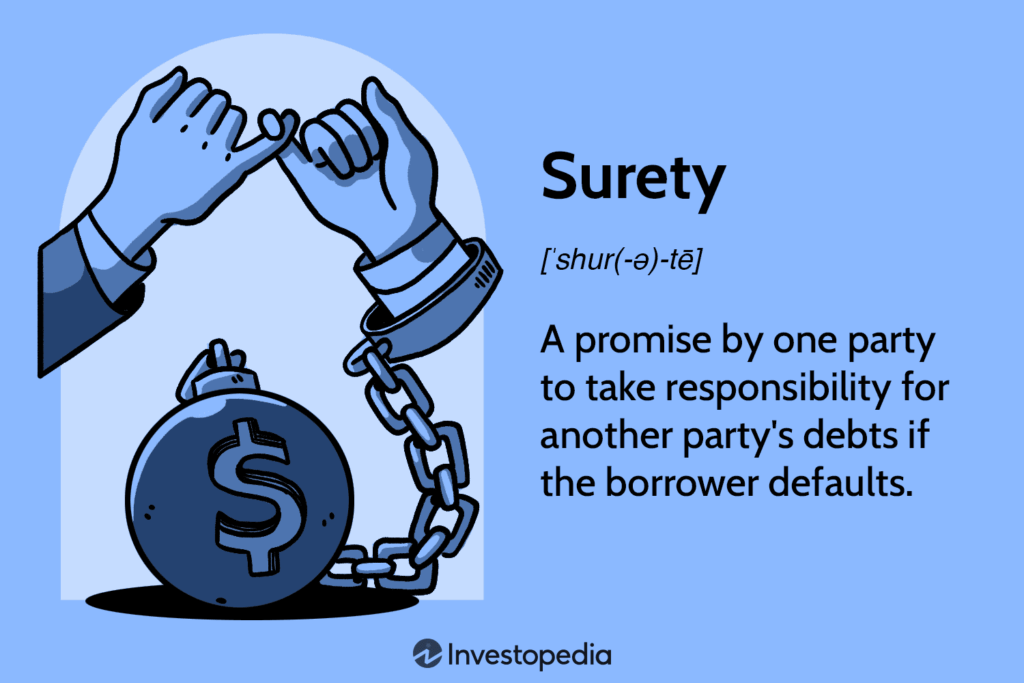
What Is a Surety Bond?
A surety bond is a three-party legal agreement that guarantees one party will fulfill a contractual or legal obligation.
The three parties are:
- Principal – The business or individual purchasing the bond.
- Obligee – The organization requiring the bond.
- Surety Company – The company issuing the bond and guaranteeing performance.
If the principal fails to meet their obligations, the surety may compensate the obligee and later recover the amount from the principal.
Unlike insurance, a surety bond is a financial guarantee rather than protection against accidental losses.
Surety Bond Meaning
The meaning of a surety bond is simple.
It guarantees that contractual obligations, legal requirements, or licensing conditions will be completed according to the agreed terms.
Many government agencies and private organizations require surety bonds before awarding contracts or issuing licenses.
How Does a Surety Bond Work?
A surety bond follows a straightforward process.
- A client or government agency requires a bond.
- The business applies through a surety bond broker.
- The surety company reviews financial strength, experience, and credit.
- The bond is issued if approved.
- If the business fails to meet its obligations, the obligee files a claim.
- The surety investigates the claim and may compensate the obligee.
- The principal reimburses the surety for valid claim payments.
Are Surety Bonds Insurance?
No.
Although many people search for surety bond insurance, a surety bond is not the same as insurance.
Insurance protects the policyholder from unexpected losses.
A surety bond protects the obligee by guaranteeing the principal will fulfill their obligations.
With insurance, the insurer generally absorbs covered losses.
With a surety bond, the principal remains financially responsible for valid claims.
Who Needs a Surety Bond?
Many industries require surety bonding.
These include:
- Construction companies
- Contractors
- Developers
- Freight brokers
- Mortgage brokers
- Customs brokers
- Real estate professionals
- Auto dealers
- Travel agencies
- Licensed businesses
- Government contractors
- Small businesses bidding on public projects
Many government contracts require proof of bonding before work begins.
Types of Surety Bonds
Several types of surety bonds are available depending on the industry.
Contract Surety Bonds
Contract surety bonds are commonly used in construction projects.
They include:
- Bid bonds
- Performance bonds
- Payment bonds
- Maintenance bonds
These bonds protect project owners from contractor default.
Commercial Surety Bonds
Commercial surety bonds satisfy licensing or regulatory requirements.
Examples include:
- License bonds
- Permit bonds
- Customs bonds
- Court bonds
- Tax bonds
- Fidelity-related obligations
Construction Surety Bonds
Construction surety bonds protect project owners by ensuring contractors:
- Complete the project
- Meet contract specifications
- Pay subcontractors
- Pay suppliers
Construction bonding is commonly required on government infrastructure projects across Canada.
Bid Surety Bond
A bid bond guarantees that a contractor submitting a bid will:
- Sign the contract if selected.
- Obtain the required performance bond.
- Begin work according to the contract.
Without a bid bond, many public tenders will reject the submission.
Surety Bond vs Letter of Credit
Although both provide financial security, they work differently.
| Surety Bond | Letter of Credit |
|---|---|
| Third-party guarantee | Bank guarantee |
| Usually lower upfront cost | Ties up business credit |
| Does not reduce cash flow significantly | Can reduce available credit |
| Common in construction | Common in commercial financing |
Many contractors prefer surety bonds because they preserve working capital.
Surety Bond Canada
Surety bonds are widely used across Canada.
Businesses often need surety bonds for:
- Government contracts
- Construction projects
- Professional licensing
- Import and export activities
- Commercial permits
Surety bond requirements vary depending on the province and industry.
Surety Bond Ontario
Ontario businesses commonly require surety bonds for:
- Public construction contracts
- Municipal tenders
- Licensed businesses
- Commercial permits
- Development projects
Working with an experienced surety bond broker can simplify the approval process.
Surety Bond Alberta
Alberta contractors frequently obtain surety bonds for:
- Energy projects
- Infrastructure contracts
- Commercial developments
- Government procurement
Many public projects require contract surety bonds before construction begins.
Surety Bond BC
British Columbia businesses use surety bonds for:
- Construction contracts
- Licensing requirements
- Municipal projects
- Commercial developments
Bond requirements vary depending on the contracting authority.
How to Get a Surety Bond
Obtaining a surety bond involves several steps.
- Determine the required bond type.
- Complete a surety bond application.
- Provide business and financial information.
- Undergo underwriting.
- Receive approval.
- Pay the premium.
- Receive the bond certificate.
Approval times range from one business day to several weeks, depending on the bond amount and complexity.
Can I Get a Surety Bond With Bad Credit?
Yes, but approval may be more difficult.
Applicants with lower credit scores may:
- Pay higher premiums.
- Need additional financial documentation.
- Require collateral.
- Face lower bond limits.
Strong business experience and healthy financial statements can improve approval chances.
Surety Bond Cost
Surety bond cost depends on several factors.
These include:
- Bond amount
- Credit history
- Business financials
- Industry
- Project size
- Claims history
- Business experience
Most businesses pay only a percentage of the total bond value as an annual premium.
Lower-risk businesses typically receive the most competitive rates.
What Information Is Needed for a Surety Bond Application?
Most applications require:
- Business information
- Financial statements
- Personal credit information
- Project details
- Bond amount
- Company history
- Work experience
Larger construction bonds usually require more extensive underwriting.
Benefits of Surety Bonding
Surety bonding provides several advantages.
- Builds client confidence.
- Helps win contracts.
- Meets licensing requirements.
- Demonstrates financial stability.
- Protects project owners.
- Improves business credibility.
- Supports long-term growth.
Frequently Asked Questions
What is a surety bond?
A surety bond is a financial guarantee that ensures a business or individual fulfills contractual or legal obligations.
Are surety bonds insurance?
No. A surety bond guarantees performance, while insurance protects against covered losses.
How do I get a surety bond in Canada?
Apply through a surety bond broker or surety company, submit the required financial information, complete underwriting, and pay the premium once approved.
How much does a surety bond cost?
The premium depends on the bond amount, credit history, financial strength, business experience, and project risk. Most businesses pay a small percentage of the bond value.
Who needs a surety bond?
Construction companies, contractors, developers, freight brokers, licensed professionals, and businesses working on government or commercial contracts often require surety bonds.
What is the difference between a surety bond and a letter of credit?
A surety bond provides a third-party guarantee without significantly reducing working capital, while a letter of credit is issued by a bank and may tie up available credit.
Final Thoughts
A surety bond is more than a contractual requirement—it demonstrates financial reliability, protects project owners, and helps businesses qualify for opportunities they might otherwise miss. Whether you need a surety bond in Ontario, surety bond Canada, construction surety bonds, or commercial surety bonding, understanding the process before applying can save time, reduce costs, and improve your chances of approval.